
e-Invoicing isn't a separate hassle. It's just a natural step in your financial flow.
In IMFS, emitting, validating, sending and tracking documents goes hand in hand with billing, clients, and operations. This eliminates the classic disconnect between ERPs and digital tax obligations.
No external apps.
Native Compliance.
Generate invoices quickly, with all the necessary details, directly from the sales flow. Track the status of receipts in real-time.
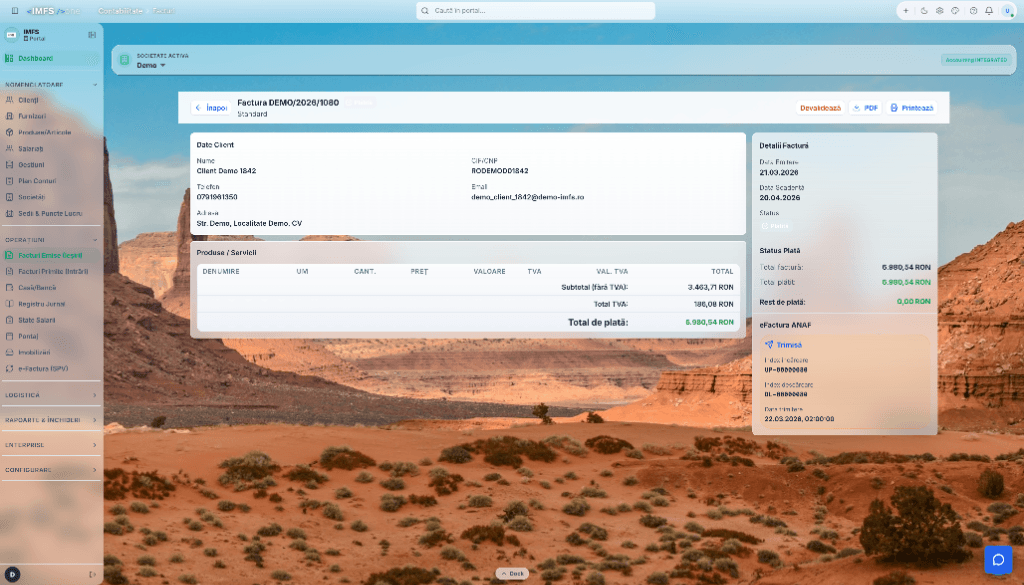
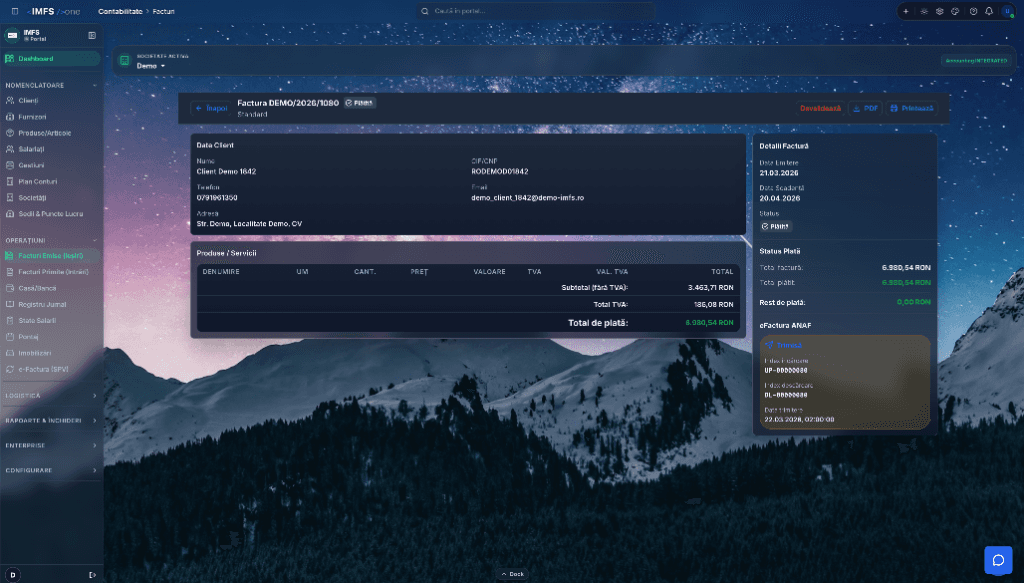
Value multiplies when it becomes part of a continuous workflow.
This is precisely what separates an enterprise product from an isolated page. We aren't merely describing independent functions, but highlighting how this module smoothly advances the entire IMFS architecture.
BPF Workflow Layout:
- Invoice
- Validation
- Submission
- Status
- Archive
- Analysis
Native Components:
- Compliance must be native: Large platforms do not treat e-Invoice as a fragile add-on, but as a natural part of the financial and commercial module.
- Fewer SPV logins: The user must stay in IMFS, where they have the complete context of the client and the invoice, not jump constantly between systems.
- More clarity on exceptions: When problems occur, the product must explain and guide the resolution, not just mark an abstract error.
- More coherent financial flow: This is where the value of the platform is seen: fiscal documents, finance, and operations are part of the same software truth.
A robust module isn't just visually stunning. It is deep, coherent, and natively connected to the rest of the ecosystem.
Issuance in the billing context
The document for ANAF must start from the natural billing flow, not from a separate application or manual steps.
Validation and correction
Companies need a clear point where they can understand and correct issues, without losing time between multiple interfaces.
Transmission to SPV
The submission step must be natural, trackable, and connected to the rest of the platform, not a repetitive external ritual.
Status and exceptions
It's important not only to send but to know immediately what happened: processing, accepted, rejected, or needs review.
Archiving and history
Fiscal documents must be stored and easily retrieved along with the invoice, the client, and the related operational context.
Frictionless compliance
When tax obligations are properly absorbed into the product, the company gains time and significantly reduces operational stress.
More than just reporting.
A completely invisible process.
Eliminate month-end panic
Traditional systems involved exporting invoices at the last minute and accountants panicking over validation errors. With IMFS, the invoice is sent to SPV the exact second it is issued to the client. Validation is instant, evenly distributing the workload throughout the month.
Automatic reception from suppliers
e-Invoicing isn't just about sending. It's also about receiving invoices from your suppliers (Utilities, Goods, Services). IMFS asynchronously downloads received XMLs directly from your company's SPV, transforming them into acquisition invoices ready for approval—even automatically generating Goods Receipt Notes (NIR) for inventory where applicable.
Native Multitenancy for Corporate Groups
If you operate multiple companies (VAT numbers) under the same entrepreneurial umbrella, you manage them all from a single IMFS account. SPV connections act independently for each company, while you get an aggregated dashboard displaying the fiscal health of your entire group.
e-Factura pe CAEN
Pagini dedicate pentru domeniile unde facturarea are reguli și documente diferite.
CAEN 41-43
Construcții
Lucrări construcții, instalații, finisaje
Deschide paginaCAEN 4941
Transport rutier mărfuri
Curse, CMR, ADR, parc auto
Deschide paginaCAEN 47
Comerț cu amănuntul
Magazine, retail, e-commerce, BTL
Deschide paginaCAEN 55-56
Hoteluri + Restaurante (HoReCa)
Cazare, restaurante, catering, evenimente
Deschide paginaCAEN 62-63
IT + Software
Dezvoltare software, consultanță, SaaS
Deschide paginaCAEN 86
Sănătate (medical)
Cabinete medicale, spitale, laboratoare
Deschide paginaCAEN 68
Imobiliare
Tranzacții, intermediere, închirieri
Deschide paginaCAEN 85
Învățământ + Cursuri
Școli private, cursuri profesionale, training
Deschide paginaCAEN 69
Activități juridice + Consultanță
Avocați, consultanți fiscali, notari, audit
Deschide paginaCAEN 4520
Service auto
Reparații, întreținere, piese auto
Deschide paginaCAEN 10-33
Producție industrială
Manufacturing, prelucrări, ambalaje
Deschide paginaCAEN 01
Agricultură
Fermieri, agricultori, lapte, cereale
Deschide paginaCAEN 35-39
Utilități + Energie
Apă, energie, gaze, salubritate
Deschide paginaCAEN 73
Marketing + Publicitate
Agenții marketing digital, PR, design
Deschide paginaCAEN 79
Agenții turism
Pachete vacanță, transferuri, bilete
Deschide paginaCAEN 4773
Farmacii
e-Factura și SAF-T automatizate pentru farmacii
Deschide paginaCAEN 46
Comerț cu ridicata (distribuție engros)
Program facturare engros integrat cu e-Factura
Deschide paginaCAEN 6920
Contabilitate & audit financiar
e-Factura și SAF-T automatizate multi-firmă.
Deschide paginaCAEN 4939
Transport persoane
Facturare simplă e-Factura pentru transport persoane
Deschide paginaCAEN 53
Curierat & servicii poștale
Facturare automată e-Factura pentru curierat rapid
Deschide paginaCAEN 61
Telecomunicații
Facturare recurentă telecom și e-Factura automatizată.
Deschide paginaCAEN 13-14
Textile & confecții
Program facturare textile și e-Factura confecții.
Deschide paginaCAEN 31
Fabricare mobilă
Program e-Factura și ERP producție mobilă
Deschide paginaCAEN 18
Tipărire & editură
e-Factura și SAF-T simplu pentru tipografii
Deschide paginaCAEN 823
Organizare evenimente & conferințe
Facturare e-Factura rapidă pentru agenții evenimente
Deschide paginaCAEN 9602
Saloane înfrumusețare & cosmetică
Facturare rapidă și e-Factura pentru saloane.
Deschide paginaCAEN 80
Pază & securitate
Facturare e-Factura automată pentru firme de pază.
Deschide paginaIf the e-Invoice stays outside the product, the user immediately feels the disconnect.
e-Invoice in IMFS is a native capability of the financial and commercial platform — exactly what raises the perception of a complete enterprise product.